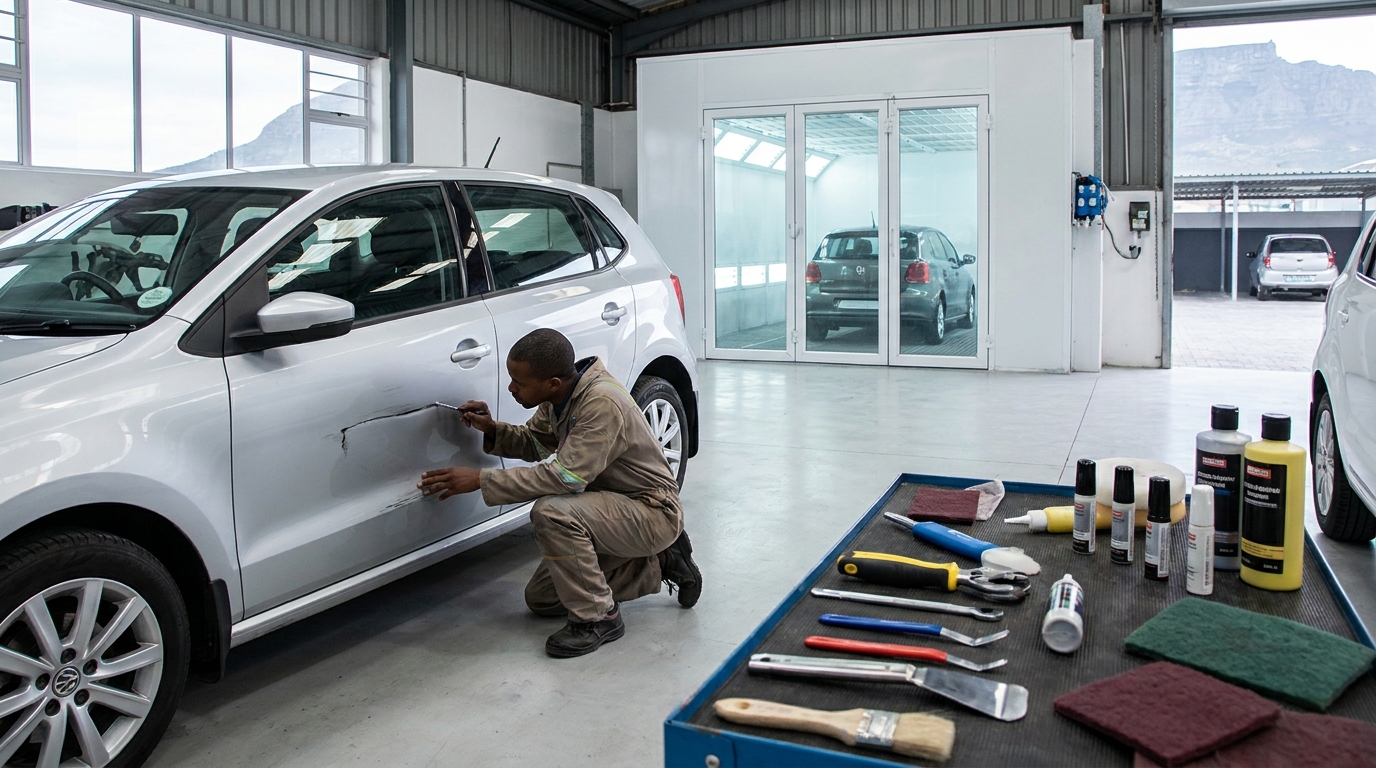
Car Scratch Repair: DIY vs Professional Panel Beater

Collision Coachworks Team
Expert Panel Beaters
Few things are as frustrating as discovering a fresh scratch on your car. Whether it's a supermarket car park door ding, a key scratch along the door, or a deep gouge from a minor collision, your first instinct is usually to weigh up your options: buy a DIY scratch repair kit or book your car into a professional panel beater. As a Cape Town driver, that decision matters — both for your wallet and for the long-term value of your vehicle.
This guide walks you through everything you need to know about car scratch repair in South Africa — from understanding the different types of scratches to knowing exactly when a professional like Collision Coachworks in Parow Industria is the right call.
Understanding the Types of Car Scratches
Not all scratches are equal. The depth and severity of the damage determines whether a DIY approach is even possible, and understanding this first saves you a lot of time and money.
Clear Coat Scratches
Modern vehicles have a multi-layer paint system: primer, base coat (colour), and a clear protective topcoat. The shallowest scratches only affect the clear coat. You can often feel these scratches with a fingernail — if your nail doesn't catch in the groove, it's likely just the clear coat. These are the best candidates for DIY repair.
Paint Layer Scratches
Deeper scratches that cut through the clear coat into the colour layer expose the base coat. You'll typically see a white or silver line where the original colour has been scraped away. These require more skill and the right products to fix properly.
Primer-Deep and Metal-Deep Scratches
The most serious scratches penetrate all the way to the primer layer or bare metal. These are immediately visible as a dull white or exposed grey metal. Left untreated, especially in Cape Town's coastal environment, bare metal will begin to rust within weeks. These scratches always require professional attention.
The DIY Route: What's Involved and Where It Fails
Walk into any Autozone, Midas, or Makro and you'll find a wall of scratch repair products — polishes, touch-up pens, scratch removers, rubbing compounds. The marketing makes it look simple. The reality is more nuanced.
What DIY Kits Can Achieve
For genuine clear-coat-only scratches, a quality polishing compound or scratch remover can work well if applied correctly. The compound works by gently abrading the clear coat around the scratch until the surface levels out. Products like Turtle Wax Scratch Repair or Meguiar's ScratchX can produce acceptable results on minor surface scuffs when used with a dual-action polisher — doing it by hand often creates swirl marks or uneven results.
Touch-up paint pens are another common DIY solution. They're available for most vehicle colours and can fill in light scratches. However, colour matching is notoriously difficult. Even if you buy the exact factory colour code for your car, touch-up paint rarely blends seamlessly — especially on older vehicles where the body colour has faded slightly over time.
Where DIY Scratch Repair Goes Wrong
- Colour mismatch: Factory paint codes provide a starting point, but matching a faded, sun-exposed finish is a skill in itself. A patchy repair often looks worse than the original scratch.
- Texture mismatch: Professional spray paint creates an even, fine-textured finish. Brush-applied touch-up paint almost always looks lumpy or glossy in a way that stands out.
- Incorrect application: Applying too much polishing compound, using circular hand motions, or working in direct sunlight are common errors that can dull the surrounding paint or create new swirl marks.
- Making it permanent: Applying touch-up paint over a scratch that needs professional prep work can make the repair significantly harder and more expensive later. Paint layers on top of improperly cleaned or primed surfaces peel and crack.
- Missing the rust window: Scratches that reach bare metal on vehicles driven near the coast (Blouberg, Table View, Sea Point, Muizenberg) can begin to rust rapidly in Cape Town's salty, humid air. A DIY patch can hide the rust while it spreads beneath the surface.
The Professional Panel Beater: What They Actually Do
At Collision Coachworks in Parow Industria, scratch repair is a methodical, multi-step process — not a quick paint pen swipe. Here's what professional scratch repair looks like:
Assessment and Preparation
A professional starts by cleaning the area thoroughly and assessing the full depth and extent of the scratch. What looks like a single scratch in a parking lot often reveals multiple overlapping marks or stone chips once properly lit. Any rust or loose paint is removed before any filling or painting begins.
Filling and Priming
For scratches that penetrate to the metal, the area is feathered out, filled if necessary, and primed. Primer seals the bare metal from moisture and provides a uniform base for the colour coat. Skipping this step is one of the most common mistakes DIY repairers make — it always shows up later.
Colour Matching
Professional panel beaters use computerised colour-matching systems to mix an exact formula for your vehicle's specific colour — accounting for fade, factory variances, and metallic flake orientation. This is the step that separates a professional result from a DIY one. The mixed paint is then applied in a climate-controlled spray booth to prevent dust contamination and ensure even coverage.
Clear Coat and Blending
After the colour coat, a clear coat is applied to protect and give depth to the finish. Skilled technicians blend the repaired area into the surrounding panels so there's no visible demarcation line. Finally, the area is machine-polished to achieve a factory-level gloss.
Cost Comparison: DIY vs Professional in South Africa
Let's be direct about costs, because this is usually the deciding factor.
DIY Costs
- Basic scratch remover / polish: R150 – R500
- Touch-up paint pen: R100 – R300
- Full DIY scratch repair kit: R300 – R800
- Dual-action polisher (if you don't own one): R800 – R2,500
If you already own a polisher and the scratch is truly superficial, the product cost might be R200–R400. But if you need to buy a polisher, or if the repair doesn't work and you need to redo it professionally, costs escalate quickly.
Professional Panel Beater Costs
- Minor clear coat scratch repair (per panel): R500 – R1,500
- Paint layer scratch with colour match: R1,500 – R3,500
- Deep scratch with primer/metal exposure: R2,500 – R6,000+
- Full panel respray (when blending is required): R3,000 – R8,000
Prices vary depending on vehicle size, panel location, colour complexity (solid vs metallic vs pearl), and the extent of damage. At Collision Coachworks we always provide a written quotation before any work begins.
When DIY Is Acceptable (and When It's Not)
DIY Is Reasonable When:
- The scratch only affects the clear coat (fingernail test: nail doesn't catch)
- The affected area is small (less than 5cm)
- You're not planning to sell the vehicle soon
- The vehicle is older and cosmetic perfection isn't a priority
- You're comfortable with the risk that results may be imperfect
Always See a Professional When:
- The scratch reaches bare metal or primer — rust risk is real in Cape Town's climate
- The scratch is on a visible panel (bonnet, door, rear quarter panel)
- The vehicle is under manufacturer warranty or a finance agreement that requires maintained condition
- You're planning to trade in or sell the vehicle — uneven DIY repairs reduce trade-in value significantly
- The scratch is large, spans multiple panels, or involves a complex metallic, pearl, or tri-coat colour
- The scratch occurred in an accident that may have affected panel alignment or structure beneath the surface
The Insurance Angle: Claiming vs Paying Out of Pocket
For many South African drivers, a scratch repair decision also involves insurance. If the scratch is minor, claiming from your insurance might not make financial sense — especially if your excess is R3,000 or more. A claim also affects your no-claims bonus, potentially increasing future premiums.
However, if the damage is significant — a deep key scratch along the full length of a door, or scrape damage from a collision — claiming is likely worth it. A professional panel beater like Collision Coachworks works directly with all major South African insurers (OUTsurance, Discovery, Santam, King Price, Hollard, and others) and can assist you through the assessment and approval process.
For minor out-of-pocket repairs, our team can provide a competitive quote that often makes more sense than claiming. We're located at 9 Assegaai Road, Parow Industria — easily accessible from Bellville, Goodwood, Brackenfell, Durbanville, and across the Northern Suburbs.
Protecting Your Paint After Repair
Whether you've had a scratch professionally repaired or managed a minor one yourself, protecting your paintwork afterwards is important:
- Apply a quality wax or sealant to the repaired area after any professional repair — most panel beaters recommend waiting 30 days before waxing a fresh respray
- Use a paint protection film (PPF) on high-risk areas like the leading edge of the bonnet and door edges
- Park strategically — end bays in car parks reduce the risk of door dings from neighbouring vehicles
- Wash your car regularly in Cape Town — road grime and industrial fallout from Parow Industria and surrounding areas contain abrasives that cause micro-scratches over time
- Rinse off bird droppings immediately — bird excrement is acidic and etches clear coat within hours in summer heat
Conclusion: The Right Tool for the Job
When it comes to car scratch repair in South Africa, the honest answer is that DIY has a narrow window of effectiveness. For genuine surface-level clear coat marks on a car you're not looking to sell, a quality polish or scratch remover can work. But for anything deeper, anything on a visible panel, or any scratch that's been sitting long enough to attract rust — professional repair is the smarter investment.
A poorly executed DIY repair can cost more to undo than the original scratch would have cost to fix properly. More importantly, it can mask deterioration that reduces your vehicle's structural integrity and resale value.
At Collision Coachworks, we handle everything from minor scratch touch-ups to full panel resprays, using computerised colour matching and factory-standard techniques. Our workshop serves drivers across the Cape Town Northern Suburbs — Parow, Bellville, Goodwood, Brackenfell, Durbanville, and beyond.
Get a free, no-obligation quote today. Visit us at 9 Assegaai Road, Parow Industria, call us directly, or use the contact form on our website. We'll assess your scratch, give you an honest recommendation, and get your car looking its best — without the guesswork.
Share Article
Need Expert Advice?
Get personalized consultation from our master technicians.
Related Articles
Car Scratch Repair: DIY vs Professional Panel Beater
Should you fix car scratches yourself or call a panel beater? Compare DIY kits vs professional car scratch repair South Africa drivers rely on — costs in ZAR, depth checks, and when Cape Town workshops are worth it.
Panel Beaters in Parow: Why Location Matters for Quality Repairs
Why location matters when choosing panel beaters Parow drivers trust. Compare workshop capability, turnaround, insurance handling, and Northern Suburbs access from Collision Coachworks in Parow Industria.
Paintless Dent Removal vs Traditional Panel Beating: Which Is Right for You?
Compare paintless dent removal vs panel beating for Cape Town cars. Learn costs in ZAR, timelines, when PDR works, and when traditional repair is essential.